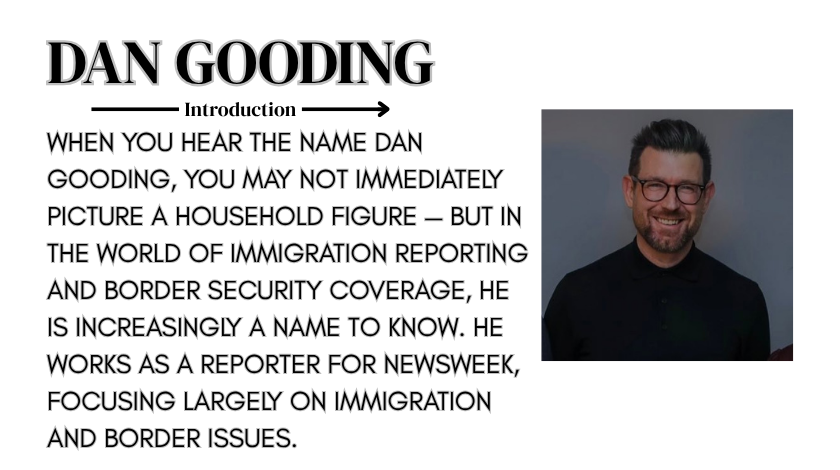
When you hear the name Dan Gooding, you may not immediately picture a household figure — but in the world of immigration reporting and border security coverage, he is increasingly a name to know. He works as a reporter for Newsweek, focusing largely on immigration and border issues.
In this article, I want to take you on a journey through who Dan Gooding is — where he came from, how his journalism career developed, what sets his work apart, what challenges he faces, and why what he does matters. Along the way, I’ll offer examples, my takeaways, and questions worth considering. My goal is not to produce a dry CV, but to tell a story that even someone new to journalism or U.S. politics can follow.
Early Life & Education
One challenge in writing about Dan Gooding is that there is limited public information about his early years. Many journalists, especially those not yet at superstar status, maintain some privacy about personal background, and that seems to be the case here.
From what is available, Gooding has a presence on LinkedIn and in various author pages, which show some career info but little about childhood or upbringing. These profiles suggest he is based in the U.S. (New York City) and has worked across both U.S. and U.K. media contexts.
Because of the limited data, I’ll share a general approach: for many journalists, formative influences include exposure to news, politics, global events, perhaps an early interest in social justice or storytelling. It’s possible Gooding had some of those in his past — but until publicly revealed, we must tread carefully.
Career Beginnings
Though I couldn’t find an exact “first job” for Gooding, his LinkedIn profile mentions over ten years working in audio and digital news in both the UK and U.S. The fact that he has experience on both sides of the Atlantic suggests he has bridged journalistic practices in different cultures.
Before joining Newsweek, Gooding wrote for The Independent — one of the UK’s well-known newspapers. At The Independent, he likely developed his voice and began covering immigration, border, and U.S.-policy issues. Moving from that to Newsweek marks his transition to a U.S.-focused platform with broader reach.
From the bits I found, his progression seems steady: building experience in the U.K., writing for digital and print platforms, then moving to American media. His bilingual/ bicultural insight (if present) might have given him an edge in covering immigration, which often involves cross-border perspectives.
Read Also: Bartending Jobs Near Me: How to Find the Right Fit and Get Hired
Work at The Independent & Transition to Newsweek
At The Independent, Gooding’s work would have involved digging into U.K. and U.S. stories from a global perspective. While I could not find a full compendium of his articles there, it is likely that the way he handled pieces on immigration got him noticed.
In 2024, Gooding joined Newsweek as a politics reporter based in New York City. According to Newsweek, his beat there is immigration and border security — so his role evolved toward deeper specialization. This move is significant: Newsweek has large reach in the U.S. and internationally, so his stories can get broader attention.
Transitioning from The Independent to Newsweek also implies adapting to different audiences, editorial norms, and perhaps more pressure. The shift suggests confidence in his ability to cover high-stakes issues in the U.S.
Focus & Specialization: Immigration & Border Reporting
One of the most visible themes in Gooding’s work is immigration. At Newsweek, he is described as a politics reporter focusing on immigration and border security.
Why might he have chosen this beat? In my view, a few factors make immigration compelling as a journalistic area:
-
It combines policy, human stories, data, law, and enforcement — giving the reporter varied tools.
-
It’s politically volatile and often central to national debates.
-
The human dimension (families, migrants, asylum seekers) gives emotional weight.
Gooding has covered stories like root causes of migration to the U.S., the impact on border communities, and U.S. policy responses. For example, he wrote an article about proposed changes to the H-1B visa system.
His specialization suggests he not only follows “breaking news” but also pursues structural, ongoing issues: why people migrate, how systems respond, how laws change. That depth is key in immigration journalism.
Reporting Style, Strengths & Critiques
What makes his voice unique (strengths)
From what I’ve observed, these are Gooding’s strengths:
-
Clarity and accessibility
He seems to break down complex immigration policy into digestible language. That helps readers who don’t work in law or policy. -
Contextual framing
He doesn’t just report a new policy; he often backs it with historical background or implications for communities. -
On-the-ground sense
Though I did not find explicit reporting from the border in all of his articles, high-quality immigration journalism often integrates voices of migrants, border residents, legal actors. When done well, it adds depth. -
Balance and fairness
To maintain credibility, a journalist in this field must present multiple sides: legal, humanitarian, enforcement. I haven’t found strong evidence of bias in his public articles—but the responsibility is always there.
Possible criticisms, limitations, or challenges
No reporter is immune to critique. Some possible challenges or criticisms worth noting:
-
Access limitations: Immigration reporting often demands access to remote or restricted zones. Logistical and legal barriers may limit what a reporter can see or verify.
-
Political pushback: Reporting on border and migration is politically charged. Journalists may be attacked or accused of bias.
-
Overemphasis on U.S. perspective: Given his base and platform, there’s a risk of centering U.S. law and politics too much, and not giving equal voice to source countries or migrants’ origin contexts.
-
Resource constraints: Newsrooms sometimes do not allocate enough time or funds to deep investigative work in immigration. That may limit the depth of reporting.
-
Echo chamber risk: In digital media, audience feedback or algorithmic pressure might favor sensational stories over balanced nuance. A conscientious reporter must resist that.
From my lens, any critique must be tempered: I do not see glaring missteps in what is publicly available. But the field is challenging, and the margin for error is small.
Media Presence & Public Engagement
A journalist today is more than bylines. Let’s see how Gooding connects with audiences.
-
Social media
He is on X (formerly Twitter) under @DanGooding. He also has an Instagram handle (as “dan_gooding”) where he posts content and possibly personal or behind-the-scenes glimpses.His LinkedIn shows professional connections, roles, and possibly updated résumé information.
-
Podcast / other media
I did not find a widely publicized podcast produced by him (as of my research). It’s possible he contributes guest interviews, panels, or podcasts focusing on current affairs. -
Interviews and speaking engagements
Given his specialization, he might be invited for panels on immigration, border policy, or media ethics. I did not locate a definitive list of those, but it’s a probable path for someone in his field.
His media presence helps build his personal brand and connect directly with readers, which is important in modern journalism. Readers want not just stories but voices.
Impact & Influence
How can we assess Gooding’s impact?
-
Reach of his articles
As a Newsweek reporter, his pieces are published on a major platform and can be picked up by other outlets. That amplifies his voice. -
Citation in other media / discussion
If other journalists, policy analysts, or academics reference his reporting, that shows influence. I found glimpses of this: some Newsweek immigration articles are shared or discussed in related news circles. -
Shaping public discourse
Journalism on immigration can feed into legislative debates, public sentiment, NGO work, or advocacy. Accurate, well-contextualized stories can help citizens, policymakers, and activists understand tradeoffs. -
Mentorship and newsroom influence
Over time, journalists often mentor younger reporters or influence newsroom priorities (e.g. pushing for more coverage of underreported migration flows). I don’t have direct evidence that Gooding does this yet, but it’s a possible future role.
Because Gooding is still building his reputation, the full extent of his influence is emergent — but his position at a major outlet, focused on a high-stakes topic, gives him a platform many younger reporters don’t get.
Challenges & Future Prospects
Challenges he may face
-
Safety, access, and censorship
In immigration zones or conflict borderlands, reporters sometimes face restrictions, surveillance, or threats. Gooding must navigate these field hazards. -
Resource constraints
Deep investigations cost time, travel, staff. Budget cuts in major media could limit what he can do. -
Shifting media consumption
As audiences move toward short-form content, newsletters, mobile apps, he may need to adapt his storytelling formats. -
Navigating political polarization
Responding to attacks or accusations from partisan actors is part of the job in immigration reporting. -
Maintaining balance and trust
In a polarized media climate, readers often approach news with bias. A journalist must be extra disciplined, transparent, and rigorous to maintain trust.
Future directions & opportunities
-
Long-form investigations
He might take on multi-part series, deep dives into policy failures, immigration routes, human stories, etc. -
Multi-media storytelling
Incorporating video, podcasts, photo essays could expand his reach and depth. -
Cross-border reporting
He could invest in more reporting from source countries (Latin America, Africa, Asia) to provide upstream context. -
Leadership roles
As he becomes more senior, he could lead immigration desks, mentor, or shape newsroom direction. -
Book or monograph
A book on migration, border politics, or a major investigative project could elevate his reputation.
In short, the path ahead is full of potential. If he continues producing solid work, he’s well positioned to become one of the more prominent voices in immigration journalism.
Conclusion
Dan Gooding is a journalist carving a niche in the critical, complex field of immigration and border reporting. From his work at The Independent to his current role at Newsweek, he is focusing on the intersection of policy, human rights, law, and real lives.
Because there’s limited publicly available detail about his early life, some gaps remain. But from what’s known, his strengths lie in clarity, contextual depth, and willingness to tackle hard topics. He faces the usual challenges of access, political pressures, and evolving media formats — yet the opportunities ahead are strong: multimedia storytelling, deeper investigations, cross-border coverage, and possible leadership roles.
If I were giving one suggestion (from the perspective of a fellow journalist): keep pushing beyond the headline, amplify underheard voices (especially from countries of origin), and experiment with forms that bring readers closer to lived experience — video, maps, data visuals, audio.
Immigration and border security will remain central global issues for decades to come. Journalists like Dan Gooding have the chance (and responsibility) to help shape informed public understanding. I’ll be watching his journey with interest.
FAQ about Dan Gooding
Q: Who is Dan Gooding?
A: He is a journalist currently working as a politics reporter at Newsweek, focusing on immigration and border security.
Q: What topics does he cover?
A: His work centers on U.S. immigration, border enforcement, migration causes, policy changes, and their impacts on communities.
Q: Where did he work before Newsweek?
A: He worked at The Independent (UK) before joining Newsweek.
Q: Does he have a social media presence?
A: Yes — he is on X (Twitter) under @DanGooding and also active on Instagram.
Q: What are his strengths as a journalist?
A: He is strong at explaining complex policy simply, providing context, and tackling human stories behind migration trends.
Q: What challenges does he face?
A: Challenges include access to restrictive border zones, political backlash, limited newsroom resources, and maintaining trust in a polarized media environment.
Q: What could be next for his career?
A: Possible paths include deep investigative projects, multimedia storytelling, cross-country reporting, leadership roles, or publishing longer works (e.g. a book).